Pages

Monday, March 28, 2016

Changu Narayan Temple

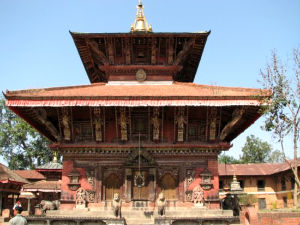
Changu Narayan Temple, the most seasoned sanctuary in Kathmandu valley came in presence in fourth century. The sanctuary is enhanced by a portion of the best example of stone, wood, and metal specialty in the valley. The sanctuary remains as the encapsulation of society, religion, history and confidence of the Kathmandu valley.

Quick Facts

Location 22 km from Kathmandu

Importance Oldest sanctuary in Kathmandu valley

Fabricated in 4th century A.D.

Given to Hindu Lord Shiva

Major Attraction Vishnu picture with ten heads and ten arms

Verifiable Importance

It is the most seasoned sanctuary in Kathmandu valley.

A Vishnu symbol with ten heads and ten arms is a fine case of stone cutting from the fifth century.

The sanctuary is of incredible significance because of its godlike objects and hallowed places having rich engineering magnificence.

Spots To Be Seen

Garuda Narayana Temple

Place of worship of King Bhupalendra Malla and his mom

Krishna Shrine

Nateshvara Shrine

Model of Sri Mahadev

Model of Garuda

Place of worship of Somalingeshvara

Models: Vishnu, Durga Avalokitesvara and Garuda Ganesh

Ganesh Shrine

Bhagvati Temple

Vishnu Vikranta

Vishnu Vishvarupa

Lakshmi Temple Shiva Temple

Stone Column

Fanciful Places In The Temple

Garuda Idol

Inside the Changunarayan sanctuary is a regarded figure of Garuda. The statue is offered desserts by the fans each year on Nag Panchami. This is done in recognition of the epic battle with the colossal snake Taksaka. The drops of dampness, accepted to be powerful against infections, for example, uncleanliness and ulcers, are gathered by the ministers.

Lord Bhupendra Malla Statues

Statues of King Bhupalendra Malla of Kathmandu and his mom can likewise be found in a place of worship. Ridiculous battling portrayed their legislative issues amid the seventeenth century yet both were liberal when it came to worshiping the divine beings.

Vishnu Sculpture

Toward the north of the sanctuary is a model of Lord Vishnu situated on Garuda (Garudasana Vishnu). This picture shows up on the Nepalese 10 rupee note. Vishnu model goes back to ninth century.

Vital Vishnu Sculptures

Vishwaroop

Vishwaroop figure, going back to eighth century A.D., presents Lord Vishnu in his general structure.

Vishnu Vikrant

The stone symbol, beholding back to the eighth century A.D, is of the most capable type of Lord Vishnu. It is identified with the Hindu legend of Vaman, an incarnation of Vishnu, who measured space with feet.

Vishnu Riding Garuda

This figure of Vishnu mounting Garuda, the legendary feathered creature, goes back to the tenth century A.D.

Narsimhha Vishnu

This type of Lord Vishnu, the Narsimha, is down the middle human and half lion structure.

The Sagarmatha National Park

The Sagarmatha National Park is the most elevated national park in world, situated above 3000 meters i.e. 9700 feet. The recreation center contains the upper catchment regions of Dudh Kosi and Bhote Kosi Rivers. Most part of the scene is tough landscape and chasms of the high Himalayas.

The Park is situated in the midst of the tops which are included among the tallest the world. Mount Sagarmatha is none other than Mt. Everest itself. Other surely understood crests, for example, Lhotse, Thamerku, Pumori, Ama Dablam, Cho Oyu, Kwangde, Kangtaiga and Gyachyung Kang are additionally found adjacent. More than 118 types of winged animals and 26 types of butterflies dwell in the recreation center.


UNESCO World Heritage Site

The Mt. Sagarmatha (Everest) and the encompassing regions are imperative to Nepal as well as to whatever remains of the world. as well. Its acknowledgment as a National Park subsequent to 1976 means to secure its special social, physical and investigative qualities.

The UNESCO perceived Sagarmatha National Park as a world legacy site in 1976 as the recreation center 'contains superlative regular excellence and is of extraordinary tasteful significance'.


Fauna

Animals that can be seen in the natural life voyage through the recreation center are taking after:

Imperiled Animals : Endangered creatures dwelling in this park are Snow Leopard, Musk Deer, Wild Yak, Red Panda and Himalayan Black Bear.

Huge Mammals : Big warm blooded creatures normally found in the recreation center are the Himalayan Tahr and Musk Deer.

Different Mammals : Other warm blooded creatures incorporate the Himalayan Black Bear, Jackal, Weasels, Marten, Common Langur and the Himalayan Mousehare (Pika).

Feathered creatures : The recreation center is the habitation of more than 118 types of winged creatures. The most widely recognized ones are the Impeyan Pheasant (Danphe), Redbilled Chough, Blood fowl and Yellow-charged Chough.

Greenery

Pine and hemlock woods are found at the lower rises of the recreation center. Above 3500m, trees, for example, birch, rhododendron, silver fir and juniper trees can be seen. Rhododendron show iridescent hues in spring and rainstorm seasons. The tree line in the district is at 4500m. Birch offers approach to juniper and rhododendron cleans. The recreation center scene is cut by profound waterways and icy masses. It can be isolated into four climatic zones:

The Lower Forested Zone where Juniper, Birch, Blue Pines, Bamboo, Firs and Rhododendon develop.

The Upper Zone where vegetation is constrained to Lichens and Mosses.

The Artic Zone where plants stop to develop.

Exercises

Nature Walk

The recreation center can be best experienced by walking. Nothing can coordinate the walker's feeling of energy at complete combination with the universe of Nature by watching the recreation center's vegetation and untamed life.

Trekking

From Sagarmatha National Park, trekking trail to Kala Pathar Peak is the most prominent, however the treks to Gokyoand Chukung Valleys are no less exciting.

Spots Of Interest

Aside from the extraordinarily shifted widely varied vegetation and also the great mountain view of the recreation center, there are a few religious communities and gompas in the Sagarmatha National Park premises that hold the voyagers' consideration. Here is brief infomation about such places.

Park Visitor Center

It is situated at Mendalphu i.e. the recreation center's Headquarters. While staying at Namche Bazar, keep in mind to visit the normal history and social legacy exhibition hall.

Thame Gomba

It is a standout amongst the most vital religious focuses in the zone. Prestigious Mani Rimdu celebration is praised here in May.

Khumjung Gomba

In June the Dumje celebration is seen here and also at the religious communities of Namche and Pangboche.

Highlights

Heavenly mountains, icy masses and profound valleys, ruled by Mount Everest, the most astounding crest on the planet (8,848 m).

A few uncommon animal categories, for example, the snow panther and the lesser panda, can be found in the recreation center.

The vicinity of the Sherpas, with their one of a kind society, makes the site all the more fascinating.

Annapuna Circuit


Set out on an otherworldly 21 days Annapurna Circuit Trek which takes us around the whole Annapurna massif achieving the Zenith at Thorong La Pass (5,416m/17,769ft). Simply envision the rushes of strolling through world's most profound Kali Gandaki Gorge, with Annapurna I ascending to 8091m toward the east and Dhaulagiri drifting at 8167m toward the west! Cross the most elevated pass, Thorong La in transit from Manang to Muktinath, relish the fantastic mountain sees from the summit of Poon Hill at 3,210m (10,531ft) and find more than ten distinctive socially rich ethnic gatherings that live in various atmosphere zones of Annapurna Circuit. Annapurna Circuit Trek, a standout amongst the most famous great treks on the planet takes us inside of the world's tenth most elevated mountain, the Annapurna. From a simple stature of 800 meters to the high elevation of 5, 416 meters, we will go through an assorted topographical and social variety with a stunning scope of vegetation in the middle. Starting the trek from Khudi after around 8 to 9 hours of drive from Kathmandu, the underlying days of the trek includes strolling through rice ranches, backwoods and cordial towns in the lower domains of the Annapurna Conservation Area.

So what makes our excursion diverse? Street development in Annapurna Region has been a matter of dissatisfaction to numerous trekkers who try to trek in Annapurna Region. Hence, perceiving trekkers' worry Himalayan Glacier has outlined this schedule taking most extreme consideration to stay away from the street development destinations. While we maintain a strategic distance from the new street development locales, the different new and off-beaten provincial courses are being found which is matter of pleasure for sharp trekkers. For example, to dodge the vehicle streets we take the course through Khudi to Sirung Village in the underlying phase of our trek. While bypassing the conventional trekking course through Bahundada which has now been connected by a street, we appreciate home-stay at Sirung Village, where the villagers would welcome us with a few ethnic social projects. So also at later piece of trek, this agenda takes us through pristine course at Kalopani whilst keeping away from the dusty new streets around Marpha. Other than these, as Himalayan Glacier's aides are experienced and altogether educated about the range, the option courses can be taken at whatever point a need is felt. Subsequently, Himalayan Glacier guarantees that trekkers need not try with respect to the street development in a few segments of Annapurna Circuit Trekking course.

Himalayan Glacier's 21 days Annapurna Circuit Trek is an awesome basic trek for encountering the Annapurna locales. On the off chance that we need shorter trek yet in the same course, we might like Annapurna Circle Trek - 14 Days. Contingent upon the time, we can spend on furlough or we might likewise think that its fascinating to attempt Himalayan Glacier's other trek schedules, for example, Annapurna Sanctuary Trek - 14 Days or Annapurna Sunrise Trek - 9 Days.

Best Season

Spring (March to mid May) and Autumn (mid Sept to Dec) are the best seasons for the Annapurna Circuit Trekking. The climate is sunny and warm, with remarkable perspectives. However, the evenings are frosty and can tumble to the point of solidification in higher rises. Winter (Dec, Jan, Feb) is additionally useful for Annapurna Circuit trek. Just issue is cool (clearly) and may be issue because of discouraged go because of ice or snow. The trekking courses are swarmed amid Spring and Autumn yet amid Monsoon and Winter the courses are not stuffed and we could appreciate somewhat best of.

Kathmandu Durbar Square

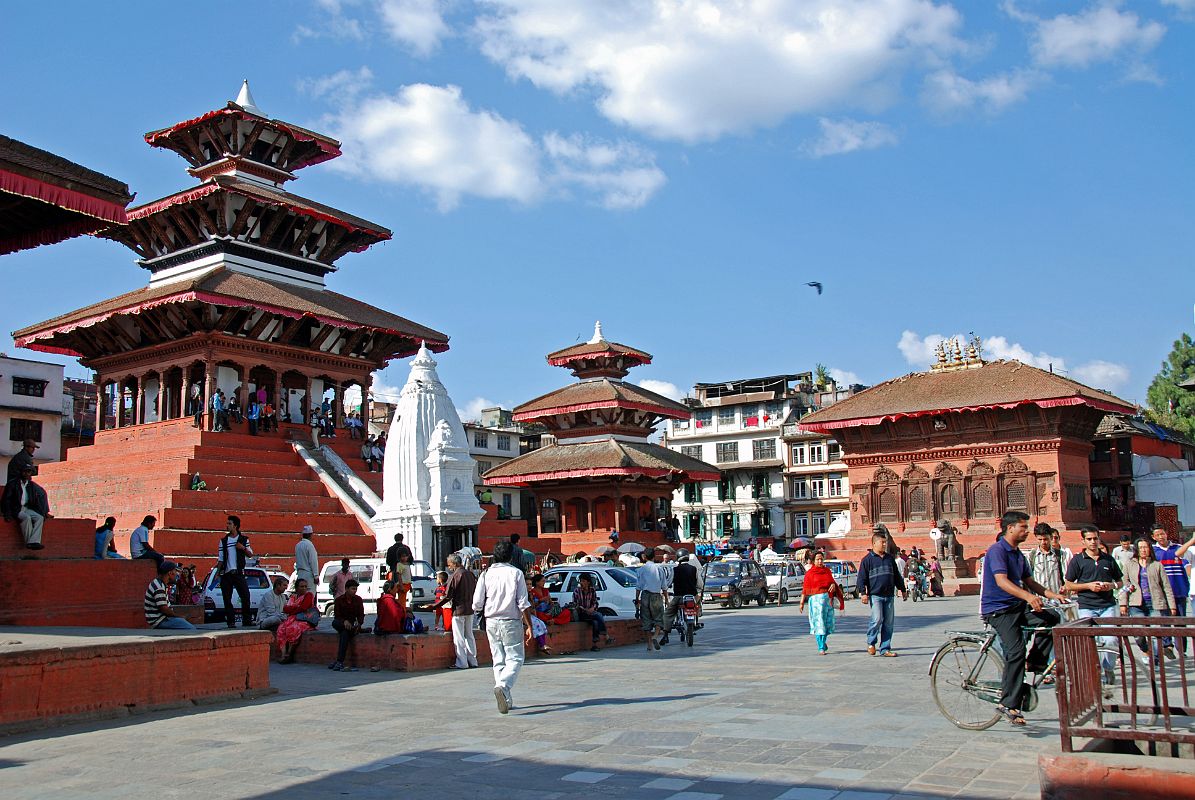
Kathmandu Durbar Square in the heart of old Kathmandu city in Basantapur never fails to impress first time visitors with its intricate wood carvings and rich history. Surrounded by concrete buildings, the complex is an oasis in a fast developing, chaotic modern city. Once the residence of Nepal's Royal family, all coronation ceremonies were held here. The palace is an amalgamation of eastern and western architecture with additions by Rana and Shah rulers over the centuries. An unbelievable 50 temples lie within the vicinity including the temple of the titular deity, Taleju Bhawani. The Durbar is divided into two courtyards, the outer Kasthamandap, Kumari Ghar, and Shiva-Parvati Temple, and the inner section consisting of Hanuman Dhoka and the main palace. Some floors have been converted to museums dedicated to three generations of Shah kings. Most parts of the palace premises are open to tourists throughout the week.

Some important monuments to see in this area are:
The Taleju Temple is the tallest of all structures, built by King Mahendra Malla in 1549 AD. This temple is open to the public for one day each year during the Dashain festival.

The Jagannath Temple, built in the 16th century is known for the fascinating erotic figures carved on the wooden struts.

The Kal Bhairav, one of the largest 17th century stone statues in Kathmandu, representing the terrifying aspect of Lord Shiva.

Swet-Bhairav - the temple is open to the public once in year during Indra Jatra Festival. The 17th century Kumari Temple (the temple of Living Goddess) is an example of highly developed Nepali craftmanship.

Kaandasthamp, from which Kathmandu derives its name, is said to have been built from the timber of a single tree.

Bhaktapur Durbar Square

Bhaktapur Durbar Square, situated in the focal point of Bhaktapur city, is a combination of pagoda and shikhara-style sanctuaries gathered around a fifty-five window castle of block and wood. The square is a standout amongst the most enchanting design masterpieces of the Valley as it highlights the antiquated crafts of Nepal. The brilliant likenesses of lords roosted on the highest point of stone monuments, the watchman gods watching out from their asylums, the wood carvings in each spot struts, lintels, uprights, tympanums, portals and windows-all appear to frame an all around arranged orchestra. The principle things of enthusiasm for the Durbar Square are:

The Lion Gate : Dating as far back as A.D. 1696, this door is monitored on either side by two gigantic statues of lions. Close by, there are two stone pictures of Bhairav (the appalling part of Shiva) and Ugrachandi (the consort of Shiva in her frightful appearance).

The Golden Gate : The Golden Gate is said to be the most delightful and luxuriously shaped example of its kind in the whole world. The entryway is surmounted by a figure of the goddess Kali and Garuda (the legendary man-winged creature) and went to by two brilliant fairies. It is likewise decorated with legendary animals of magnificent complexity, In the expressions of Percy Brown, a prominent English craftsmanship pundit and history specialist, the Golden Gate is the most flawless bit of workmanship in the entire Kingdom: it is set like a gem, blazing countless aspects in the great looking setting of its environment. The entryway was raised by King Ranjit Malla and is the passageway of the fundamental yard of the Palace of Fifty-five Windows.

The Palace of Fifty-five Windows : This brilliant castle was worked amid the rule of King Yakshya Malla in A.D. 1427 and was therefore redesigned by King Bhupatindra Malla in the seventeenth century. Among the block dividers with their benevolent setting and sculptural outline, is a gallery with Fifty-five Windows, thought to be an extraordinary perfect work of art of woodcarving.

The Art Gallery: The Art Gallery contains antiquated canvases having a place with the Hindu and Buddhist customs of different periods and portrayals. This exhibition is open ordinary with the exception of Tuesday.

The Statue of King Bhupatindra Malla: This statue indicating King Bhupatindra Malla in the demonstration of love is determined to a section confronting the royal residence. Of the square's numerous statues, this is thought to be the most great.